|
| ChrisOLeary.com > Pitching > Essays > Inverted W FAQ |
Inverted W Frequently-Asked Questions (FAQ)Updated 2014.12.14 Interest in the Inverted W has exploded since Stephen Strasburg went down with an elbow problem. As a result, many people are talking about the Inverted W and its impact on Stephen Strasburg and others like Mark Prior and Anthony Reyes. Unfortunately, a lot of what they are saying is wrong. So I have put this piece together to address some of things that are being said about the Inverted W and to clear some things up. Why NOT Call it the "M"?I didn't coin the term "Inverted W." Instead, I believe the term Inverted W was coined by Paul Nyman. I'm just sticking with his terminology since it's already out there. In fact, when I first started noticing the arm action, and before I knew that Paul Nyman called it the Inverted W and was advocating it, guess what I called it? The M. If you don't believe me, here's a thread in which Paul Nyman and I (aka justthefacts) discuss the Inverted W, which at the time I called the "M"... As to why Paul Nyman called it the Inverted W and not just the M, I assume it's due to the slight difference in the angles of the outer strokes of the letter...
...the strokes that represent the pitcher's forearms. The forearms of pitchers who make the Inverted W don't hang vertically down from the elbows; rather, they angle outwards. What Evidence do you have that the Inverted W is harmful?I have put together a piece that explains the scientific basis behind the pitcher injury and tommy john surgery epidemic. Why Exactly is the Inverted W Harmful?The problem with the Inverted W is that it can (and I mean can and not always does) create a Timing problem (aka rushing) and cause the arm to be late. That increases the distance, and thus the force, of the external rotation of the Pitching Arm Side (PAS) upper arm. That in turn increases the momentum of the PAS upper arm as it externally rotates, increasing the load on both the elbow and the shoulder.[1] When did you first figure out that the Inverted W might cause problems?I don't recall exactly when I first picked up on the Inverted W and started to suspect that it was bad, but it was probably in late 2005 or early 2006. By late 2007, and as I first made clear in my analysis of Mark Prior's pitching mechanics, I had figured out that the core problem with the Inverted W was that it tended to create a Timing problem. If you are really interested in this you can find my posts on the baseball-fever web site... ...by Googling "baseball-fever scapular loading". I post under my own name. At the time the idea of scapular loading (aka scapula loading or just scap loading) was all the rage and I was trying to decide whether it was something I should teach my pitchers or not. Dr. Mike Marshall, whose ideas I was researching at the time, thought scap loading was universally a bad idea and I initially agreed with him. However, as I started looking at pictures of pitchers and putting together my early photographic pitching mechanics analyses, I started to notice a very obvious pattern, one that was so obvious that I was surprised nobody had noticed it before; great pitchers do scap load, but they do so with their elbows well below their shoulders. In contrast, trainwrecks like Mark Prior scap load with their elbows well above their shoulders. At the same time, the father of one of my son's friends, who is a union sheet metal worker, had surgery on the rotator cuff of his right arm. It turns out that sheet metal workers, plumbers, pipefitters, and others who work with their elbows above their shoulders for extended periods of time are vulnerable to rotator cuff problems. That clued me in to the idea that the rotator cuff was sensitive to the position of the elbows. What I then started doing was Googling terms like "pitcher injury," "pitcher labrum," and "pitcher rotator cuff" and looking at the images that came up in response to those queries. I was looking for common patterns in the arm actions of pitchers with common problems, and started to see them immediately. I then came across a piece that talked about Robb Nen's unusual stride and how it was an attempt to deal with a problem with rushing and how Nen retired due to problems with his labrum. That planted the seed for a possible link between rushing and labrum problems. In early 2006, I started posting about the Inverted W at the Baseball Fever discussion board and here, here, and here at LetsTalkPitching.com in February of 2006 (coachxj is Paul Nyman). Most of those posts are still accessible. It took me a few months to convince myself that I was really on to something and that the Inverted W was something that people were being taught — or at least encouraged — to do and not just something that they were coming up with on their own. However, in July of 2006 I started blogging about the dangers of the Inverted W using Anthony Reyes as my example of a pitcher whose career was jeopardized by his use of the Inverted W. What made you realize that the Inverted W was important due to the impact on a pitcher's timing?The pitcher who made me suspect that the Inverted W, and the other inverted arm actions, could be problematic because of its impact on a pitcher's timing was Robb Nen. I remember reading a piece that discussed his odd delivery and how he used an unusual stride to try to deal with a problem with rushing. That planted the seed in my head that there might be a link between Rushing and other Timing problems and injuries. Isn't this all Just Monday Morning Quarterbacking?No. In addition to first writing about the relationship between the Inverted W and Timing problems in pitchers in late 2007, I first expressed concern about Stephen Strasburg's pitching mechanics in August 2008. Didn't Dr. Mike Marshall First Figure This Pattern Out? Aren't you just ripping off his discovery?No. Dr. Mike Marshall thinks that scapular loading is universally bad. As a result, he never thought to look for a difference between good scap loading and bad scap loading. Isn't Mark Prior a Bad Example to use Because of his other Injuries?I don't think so. However, if you don't think Mark Prior's Inverted W caused his problems, then I can just as easily say that Anthony Reyes' Inverted W caused his problems. 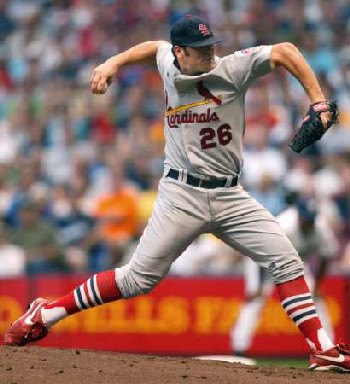
Anthony Reyes' Inverted WAnthony Reyes has the same flawed arm action as Mark Prior and Stephen Strasburg and has a very similar injury history. That's not a coincidence. It also makes the case that Tom House played a role in crafting Mark Prior's supposedly perfect pitching mechanics. Wasn't Stephen Strasburg's Elbow Killed by a Single Incorrectly Thrown Pitch?No. The phrase, "The straw that broke the camel's back," was invented for just this type of situation. The thing that killed Stephen Strasburg's elbow wasn't a single incorrectly throw pitch, it was all the pitches before that pitch that degraded his UCl to the breaking point. That last pitch just finished the job. Isn't this all the Nationals' Fault?Not really. They probably should have shut Strasburg down when his shoulder started barking, and probably shouldn't have had him pitch in the major leagues this year, but the real damage was done years ago when Strasburg developed his arm action. Was Strasburg Taught to make the Inverted W?Maybe. Maybe not. Strasburg came of age at a time when Mark Prior was still seen as one of the best pitchers out there and someone to study and copy because of his supposedly perfect pitching mechanics. In fact, I know of, and have done some talking to, one major leaguer who is having arm problems due to his Inverted W and who copied Mark Prior because it seemed like a good idea at the time. it wouldn't surprise me if Strasburg also tried to emulate Mark Prior. Are There Any Pitchers Who Have Survived the Inverted W?There are a few exceptions that I know of and they point out subtleties in the idea. Tom Glavine had a borderline Inverted W and was healthy. However, he was a soft tosser, didn't have a timing problem, and was a product of a Braves system that stressed conditioned. That makes the case that the Inverted W is a bigger problem in harder throwers (92-93+) and when it causes timing problems. It also makes the case that conditioning may be important to tolerating borderline arm actions. It may be that the Braves' conditioning program also enabled John Smoltz to tolerate his borderline Inverted W better than most. However, Smoltz also had major elbow and shoulder problems, so he was hardly clean. Don Drysdale pitched for 14 seasons with an Inverted L. However, his timing wasn't as bad as some. His career was also cut short by shoulder problems. Pedro Martinez pitched for 13 highly effective seasons with a borderline Inverted W. His career was cut short by shoulder problems. I don't think it's a coincidence that Pedro Martinez changed his arm action, and got rid of his Inverted W and improved his timing, during the come-backs at the end of his career. Bert Blyleven pitched well with a borderline Inverted W. However, he missed most of the 1982 season due to elbow problems and had effectiveness problems in 1981 and 1983. Bob Feller was a plus plus velocity guy with a borderline Inverted W. I would like to say that he makes the case for the primacy of timing over arm action as the key determinant of injury risk because his timing was good. However, Bob Feller missed 4 full baseball seasons in the middle of his career due to WWII. That could have given his arm time to heal from any underlying injuries. Due to the hole in his career, I view Bob Feller as a confounded example and don't think he says anything about the Inverted W either way. Mickey Lolich is a pitcher who I am currently researching because he did have an Inverted V in his arm action and, like Don Drysdale, he only pitched well for 14 years. However, I haven't seen any video of him to know what his timing was like. I also don't know anything about how hard he threw. About The AuthorChris O'Leary never played baseball beyond grade school due to a shoulder injury suffered due to poor pitching mechanics. As a result, he is focused on ensuring that what happened to him doesn't happen to anybody else. The Epidemic is one way he hopes to achieve that goal. Notes[1] A good paper that studies the forces on the elbow is Relationship between throwing mechanics and elbow valgus in professional baseball pitchers. |
| about | contact | copyright | sitemap | liability policy |