The Myth of the A to C Swing
Although major league hitting instructors and hitting
coordinators teach a variety of different things, perhaps the
best description of what is most commonly taught is an A to C (or sometimes A to B) swing.
It is also sometimes referred to as being short to, and long
through, the baseball.
The basic idea, which is correct,
is that a swing has to be very short in order to hit a 95
MPH fastball. The problem is that hitters are taught that they must
not allow their hands to take a
circuitous route to the pitch. Instead, the hands have to
take a direct, linear, A to C path to the ball and not a longer A
to B to C path to the ball.
While this idea makes perfect sense, and as I also
discuss in my piece
Do As They Did..., the problem is that,
if you compare how this swing is taught and demonstrated to
an actual game swing, you will see some significant
differences.
The A to C Swing in Action
If you go around the Internet, you can find numerous
demonstrations of the A to C swing.
The A to C Swing Be a Better Hitter
The A to C Swing Expert Village
The A to C Swing Derek Jeter and weplay.com
The A to C Swing Don Mattingly
The A to C Swing Curtis Wilkerson
You can also see the same desired position at the Point Of
Contact modeled in numerous still photos.
The A to C Swing
The A to C Swing
The A to C Swing
If you look at each of these swings and compare them, you
will see a number of common threads. During the swing...
- The hands move directly to the ball.
- The bat chops down on the ball.
- The barrel stays above the hands through the POC (aka no "loop" in the swing).
...and at the Point Of Contact (POC)...
- The hands are at the front hip.[1]
- The arms are extended.
- The front elbow is down.
- The bat is level to the ground.
- The wrists are unbroken.
- The barrel is lagging behind the hands.
- The back foot is squishing the bug.
The A to C Swing and Reality
While the A to C swing makes logical sense, if you look
at pictures and video clips of good hitters, you will
quickly notice that there are some significant differences
between what is demonstrated as a good position at the POC
and how good hitters actually look at the POC. Just
compare the list and pictures above to the pictures below.
Manny Ramirez's Swing Home Run
Albert Pujols' Swing Home Run
Mark McGwire's Swing Home Run
Ryan Howard's Swing Home Run
Andres Torres' Swing Home Run
In particular, if compare a game swing of Alex
Rodriguez hitting a home run to the picture of him that is used
on the cover of Kevin Long's "Pro Hitter's Workout" DVD...
Alex Rodriguez Comparison
...you will see some significant differences between the two
positions at the POC.
- His hands are not at
his front hip. Instead, his hands are out in front
and midway between his back hip and his back
shoulder.
- His arms are not extended.
Instead, his back arm is bent 90 degrees.
- His front elbow is not
down. Instead, it is up by his front shoulder.
- The barrel is not level to the ground. Instead,
it's looping down below his hands.
- His wrists are not
unbroken. Instead, they have unhinged almost
completely.
- The barrel is not lagging behind the hands.
Instead, the barrel is in line with his front arm.
- His back foot is not squishing the bug.
Instead, he's up on the point of his back toe.
As I discuss in greater detail in my piece on
Albert Pujols' Swing,
good hitters also get to this contact position quite differently
than most people teach.
Albert Pujols' Swing Home Run to Left Field
Notice how, rather than keeping the barrel above his hands
and swinging down on the ball, Albert Pujols lets the barrel
fall below his hands and then hits the ball with a slight
uppercut.
Albert Pujols' Swing Home Run to Left Field
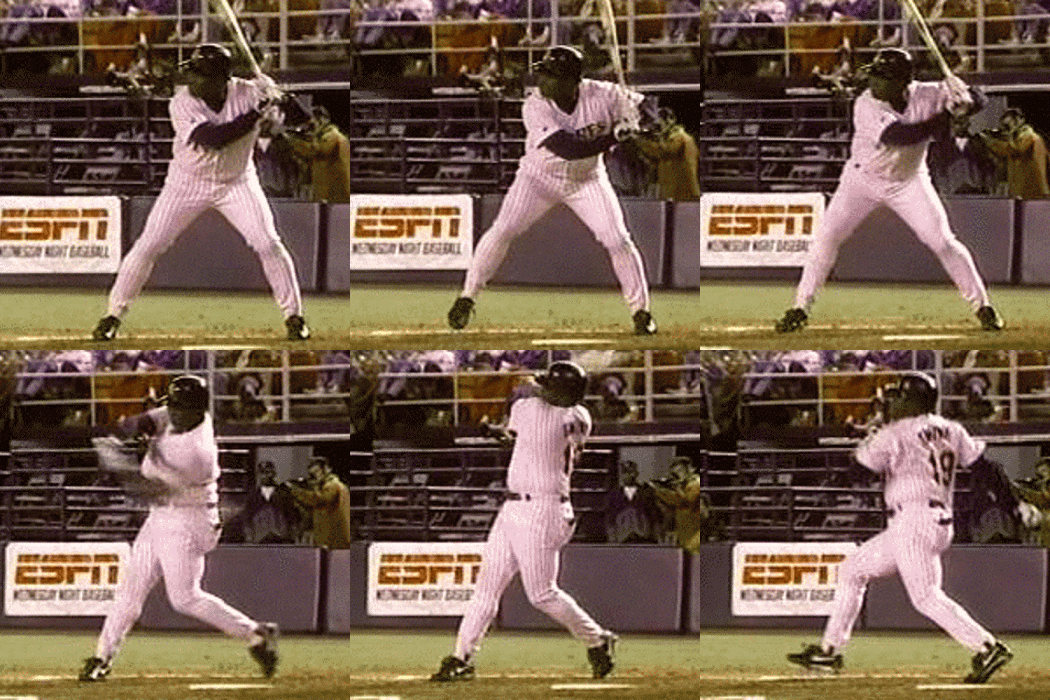
What you see in Albert Pujols' swing is what Don Mattingly, Tony Gwynn, and others
call a loop in his swing (or a Reverse C in Tony
Gwynn's terminology).
Of course, if you take a close look at the swings Don
Mattingly and Tony Gwynn, two of the biggest proponents of the A
to C swing and two of the biggest haters of the loop in the
swing, you can see loops (and uppercuts) in both of their swings.
Tony Gwynn's Swing
Don Mattingly's uppercut was particularly pronounced, since
he tended to like the ball a bit lower than Tony Gwynn. Of
course, Mattingly's uppercut was also appropriate since that is
the only way to hit a ball down in the strike zone.
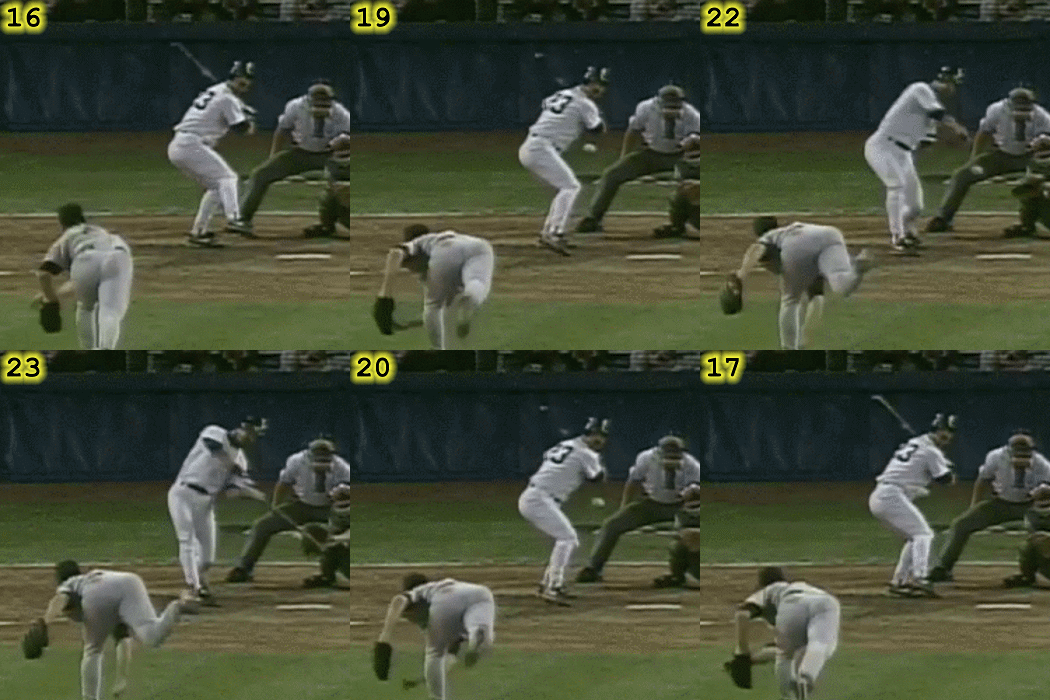
Don Mattingly's Swing
In truth, neither Don Mattingly nor Tony Gwynn actually
did much, if anything, that they currently teach.
It's Not Just Academic
I have worked with
Andres Torres for a number of years. He had an off year in
2011, and I wasn't sure why because I hadn't worked with him in
depth since 2009. We met up in January of 2012 to try to get his
swing back on track, and one thing that came up in our
conversations was that, at some point after we met in 2009,
Andres had been taught an A to C hand path, to keep the barrel
above the ball, and to swing down on the ball. The result was
that he had a hard time covering the bottom of the strike zone
because he didn't know how to cover the bottom of the strike
zone while keeping the barrel above the ball and swinging down
on the ball. Of course, that's because you can't. That is why
Don Mattingly didn't actually do what he teaches.
A Linear Hand Path?
Of course, the defining characteristic of an A to C swing is
a linear hand path in which, in Don Mattingly's words, "The
hands go directly to the baseball." However, if you look at
clips of hitters like Albert Pujols, you will see a hand path
that is anything but linear.
Albert Pujols' Hand Path
Instead, notice how Albert Pujols' hands start out on a
gently curved path and then, a few frames before the Point Of
Contact, take a hard left turn. That hard left turn is essential
to getting the bat head to Whip out into the path of the ball
and will not happen if you are trying to take your hands
directly to the baseball.
For More Information
Additional
free information about
Rotational
Hitting and the
High-Level Swing is available through
my
private client site. To access this additional
free information, and to see how much,
and what kinds, of information is available to my clients, all you
have to do is
register.
NOTES
[1] Finishing with the hands down at the
front hip is actually a major flaw, commonly referred to as
dropping the hands, that hurts hitters' ability to hit for both
power and average.
|