Pitching Mechanics Analysis
Jason Motte
2009.4.13
Updated 2015.8.24
I have updated this piece several times to take into account
what I learned as a result of my initial miss on my assessment
of Jason Motte's pitching mechanics. However, in the interests
of intellectual honesty, I have left that initial assessment up.
2015.8.24 Update
The initial version of this piece was done with Dr. Mike
Marshall's ideas about timing in mind; specifically, the idea
that it's better to be early than late. However, as my
assessment of Jaime
Garcia's pitching mechanics and
Tommy Hanson's
pitching mechanics make clear, it can be bad — and perhaps
even worse — to be early than late.
In my initial assessment of Jason Motte's pitching mechanics,
I wrote off the pause in his arm swing — how his arm stalls on
its way up to the high-cocked position and stops externally
rotating for a number of frames — as a good thing.

Jason Motte
However, and contrary to what Dr. Mike Marshall has said,
such a pause is a major problem.
It breaks the kinetic chain.
Lesson learned.
P.S. I am increasingly seeing such a pause, often combined
with re-internal rotation, in the arm actions of catchers. While
this is often labelled high-level throwing due to the short-term
velocity boost it generally delivers, it can have long-term
negative consequences for the elbow and the shoulder.
2014.12.15 Update
Arm stalls. Even internally rotates a bit.
2014.02.14 Update
Given the passing of a few years, Jason Motte's elbow blowing
up, and my falling in love with Nolan Ryan's pitching mechanics,
I've decided to take another look at Jason Motte's pitching
mechanics in relation to Nolan Ryan's pitching mechanics.
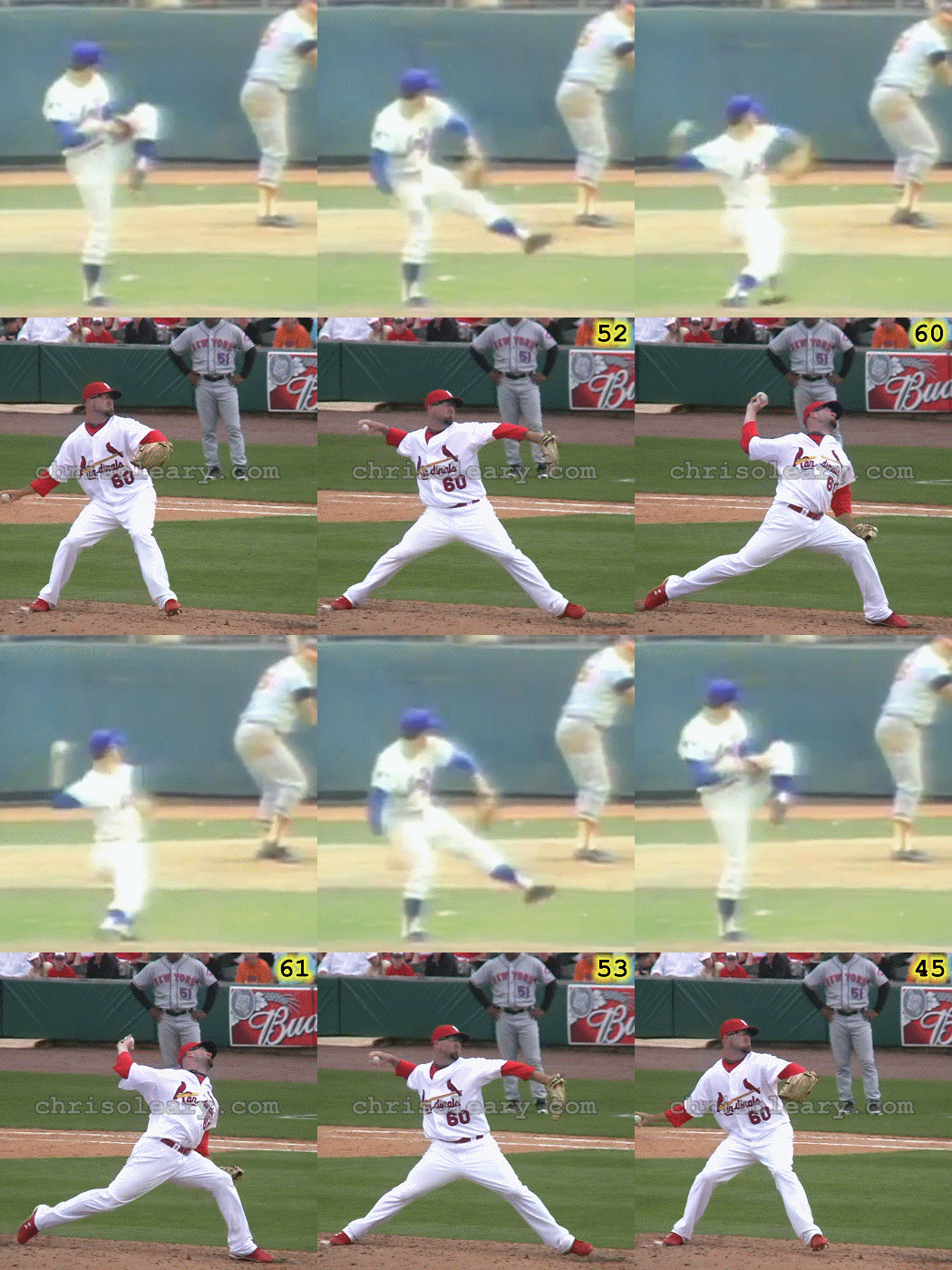
Nolan Ryan vs. Jason Motte
As is the case with
Shelby Miller's
pitching mechanics, the thing that really stands out when comparing Nolan Ryan and Jason Motte is the
mind-bottling fluidity of Ryan's pitching mechanics in
general, and arm swing in particular, compared to Motte's
herky-jerky arm swing.
Jason Motte breaks his hands early, glides down the
mound, then he has to lift with his elbows in order to try
to hold his shoulders back. The result is something that
pales in comparison to the fluidity that you see in
Nolan Ryan.
2009.04.13
I recently read, with combination of amusement and dismay, an
analysis of the pitching mechanics of Jason Motte by Alex
Eisenberg. I have multiple problems with his analysis of Jason
Motte's mechanics, and I explain those problems at the
end of
this piece.
In the meantime, let's look at the pitching
mechanics of Jason Motte using some high definition video that I shot
just a couple of weeks ago at Spring Training.
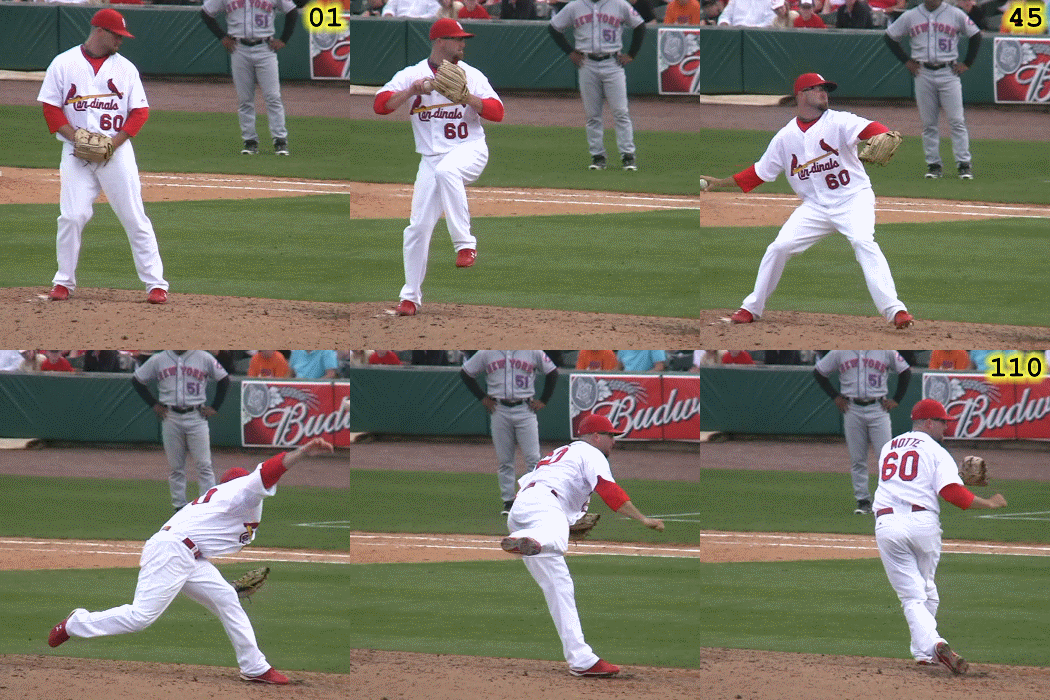
Jason Motte
Jason Motte's mechanics are generally fairly good and
reasonably safe.
First, Jason Motte
does a decent job of getting his lower body moving toward the
target through the top of his leg lift. Notice how in Frame 29
his hips are out in front of his Pitching Arm Side (PAS) foot.
Second, Jason Motte's arm action is solid. Rather than leading
with his elbows, you can that by Frame 45 Jason Motte's hand is
above the level of his PAS elbow. You can also see in Frame 56
that Jason Motte
scap loads with his elbows just below the level
of his shoulders, which is good.
Third, Jason Motte's timing looks decent. His Glove Side (GS)
foot plants and his shoulders start rotating around Frame 58, by
which time his PAS forearm is mostly vertical.
Fourth, I do think that one reason why Jason Motte's lower body
mechanics are a bit conservative, and possibly less efficient,
is that they may represent an effort to improve his control.
However, I think that effort may be misdirected. From the
standpoint of control, the thing that worries me the most about
Jason Motte is his disproportionately large head jerk. Notice in
Frame 61 how far his head, and in particular his eyes, are off
of level. While you do see big head jerks in higher arm slot
guys, it's unusual to see such a big head jerk in a guy who
throws from a 3/4 arm slot.
Finally,
you can also see an excessive amount of lean back toward First
Base in Jason Motte's torso as his PAS forearm passes through
the high-cocked position, which may be the remnant of a higher
arm slot in the past. However, this residual torso lean likely
isn't helping him and may be hurting his control. What might be
an interesting experiment is to try to lower Jason Motte's arm
slot just a bit to low 3/4. That would tend to reduce the
severity of his head jerk and would also likely improve the
movement of his fastball and could put him in Nolan Ryan
territory in terms of both the velocity and movement of his
fastball.
The Bottom Line on Jason Motte
The bottom line on Jason Motte is that his mechanics are
solid. However, he does seem to have a tendency to rush his
throws, which means that his timing may not be as consistent,
and as good, as the clip above indicates. I think the biggest
thing Jason Motte needs to work on is the stability of his head.
If he can learn to get more power from his lower body, and try
to do less with his upper body to just muscle the ball with his
arm, I could see both his control and his velocity improving.
Jason Motte Needs A Change-Up!
If I ran the zoo, I
would make Jason Motte's second pitch a change-up rather
than a slider. Given that his fast ball is so hard, but so flat (aka
straight), the only chance he has is to mess with a hitter's
timing. Hitters are going to start their swings early
in attempt to just time out his fastball. The way to defeat
that strategy is with a solid change-up that looks the same out
of the hand, not a slider that looks different right out of the
hand (and that is kind of weak and slurvy as it is).
The superficial problem with Alex Eisenberg's
analysis of the pitching mechanics of Jason Motte is that he
simply gets some things wrong. For example, he says...
It’s straight as an arrow, but it’s sneaky and gets on
hitters quick because he short-arms the ball, which dates
back to his days as a catcher.
...but video evidence (see Frame 59 of the clip above) shows that Jason Motte does not
short-arm the ball. Instead, at the high-cocked position
Jason Motte's Pitching Arm Side (PAS) forearm is at a very
neutral (neither short arm nor long arm) 90 degree angle.
Alex Eisenberg seems to be in love with the idea that the elbow
should pick up the ball...
He lets the elbow pick up the ball...
...to the point where he sees it when it isn't even there.
While some pitchers do pick up the ball with their PAS elbow,
Jason Motte doesn't. Rather than leading with his elbow out of
his hand break, by Frame 45 Jason Motte's PAS hand is above the
level of his PAS elbow and it stays there through his arm swing.
Alex Eisenberg also doesn't seem to understand why pitchers
hook their wrists. He says...
He lets the elbow pick up the ball, meaning no hook in
the wrist, like you see with Rich Harden.
...when in truth the two are totally unrelated. Letting
the elbow pick up the ball will not fix a hook in the wrist,
as the example below of Barry Zito demonstrates.
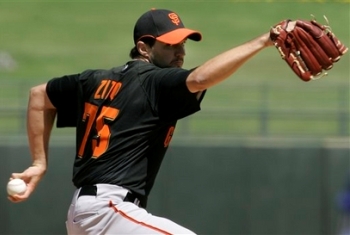
Barry Zito
Notice how Zito picks up the ball with his elbow but
still has a major hook in his wrist. In truth, the hook in
the wrist is generally due to either pre-setting a pitch or
tension in the wrist or forearm (or both).
What's worse, Alex Eisenberg doesn't seem to understand, accept, or
care about, the relationship between a pitcher's arm action and the risk
of injury...
He lets the elbow pick up
the ball, meaning no hook in the wrist, like you see with
Rich Harden. He also efficiently loads the scapula...
In truth, by letting the elbow pick up the ball, a
pitcher greatly increases the risk of developing an inverted
arm action and a timing problem as a result.
|