Pitching Mechanics Analysis
Stephen Strasburg
This piece brings together all of the pieces I have written
about Stephen Strasburg, his pitching mechanics, and his injury
history.
Tom Verducci just put together a piece that "borrows" heavily
from
my analysis of the pitching mechanics of
Stephen Strasburg (see below) and Strasburg's problem with the
Inverted W. However,
either Verducci, or the person who quoted my information to him
pretty much word for word, never talked to me.
As a result, he didn't get it quite right.
While I discuss this topic at greater length in my new piece on
Injuries to Pitchers, let me quickly go through
Tom Verducci's piece and point out
what he got right and what he got wrong.
Because his front foot lands too soon, Stephen Strasburg’s
shoulder and elbow must bear a dangerous amount of force.
This is a perfect example of what happens when you
"borrow" someone else's work without really
understanding what you are borrowing. You get stuff wrong. The problem isn’t that Stephen Strasburg's front foot
is early; that his front foot lands too soon.
There’s nothing you can do about that because the front
foot has to get down at some point.
Rather, the problem is that Stephen Strasburg’s arm is late;
his arm isn't in the correct position at the moment when
his front foot heel plants and his shoulders start
rotating. As the picture
below shows, at the moment Stephen Strasburg's front foot lands, and his shoulders start
rotating, his Pitching Arm Side (PAS) forearm, instead
of being vertical and at 90 degrees of external
rotation, is pretty much horizontal and at 0 degrees of
external rotation.
Stephen Strasburg
This is caused by the Inverted W in his arm action;
it forces his arm to take a longer path to the
high-cocked position and creates what is commonly known
as a problem with rushing. As a
result, his PAS upper arm will externally rotate
especially hard and much, which will increase the load
on both his elbow and his shoulder.
But above all others one link of the chain is most
important: the "late cocking phase," or the phase during
which the shoulder reaches its maximum external rotation
with the baseball raised in the "loaded" position
(typically, above the shoulder) and ready to come forward.
The line above is very confusing, and reflects a problem with the conventional model of the baseball
pitching cycle. The delineation between the early cocking
and the late cocking phases of the throw are very ambiguously
defined. It's one reason why I have come up with a
simplified, and
revised, baseball pitching cycle.
In addition, it's not correct that the
shoulder is at maximum external rotation when the baseball
is in the "loaded" or high-cock position. Instead,
maximum external rotation occurs after the Pitching Arm Side
forearm is vertical and the shoulders start to rotate.
Here is the key to managing the torque levels in the
late cocking phase: timing. The ball
should be loaded in the late cocking phase precisely
when the pitcher’s stride foot lands on the ground.
This is correct, but I feel like
I
have heard this before, perhaps
on my own web site where
I say...
The problem with the Inverted W is that it can (and I
mean can and not always does) create a timing problem (aka
rushing) and cause the arm to be late.
Tom Verducci then goes on to say...
Without the energy from the rest of the body, the
shoulder and elbow must bear higher levels of torque in
what in even optimum circumstances is a maneuver that
taxes the physical limits of what an arm can bear.
“Without” should really be “Because of.”
The timing problem that can be created by the use of the
Inverted W increases the energy, and thus the force, on the
elbow and the shoulder. This can overload them.
I spoke with a key decision maker for one club last week
who, speaking on the condition of anonymity, said his
club will not consider any pitcher — by draft, trade or
free agency — who does not have the baseball in the
loaded position at the time of foot strike.
I wouldn’t be surprised if this is the Mets. I have
talked to people with them since 2007 and they have bought into
my ideas.
However, once Strasburg takes the ball out of the glove,
down and away from his body, his right elbow, not his
right hand, literally takes the leading role. Like
re-writing a script, the roles in the kinetic chain are
switched. Now it is the elbow that raises higher than
the shoulder and the hand.
This is correct.
There is one moment in this sequence when both of
Strasburg’s elbows are higher than his shoulders, as if
he were locked in medieval village stocks. Many people
have frozen that moment of his delivery and assigned it
as the point of risk. That’s not entirely true.
The problem is the timing associated with that
move, not the move itself.
OK, so
Tom Verducci's clearly been reading my stuff. I say the same
exact thing in my piece on the
Inverted W...
(T)he Inverted W is not (that) bad in and of
itself. The Inverted W doesn't
directly lead to injuries. Instead,
the problem with the Inverted W is that it can
create a timing problem
I wish
that Tom Verducci, or whoever he is talking to, would stop
"borrowing" my stuff and
just give me a call so that I can make sure that he gets
this right. It would also be nice if he would acknowledge
where he's getting his information from and stop acting like
these are his words, ideas, and observations. I'm not going
to use the word, but all know what's going on here.
When Strasburg gets his elbows above his shoulders and
the baseball is below or about even with his right
shoulder, his stride foot is hitting the ground. The
ball should be in the loaded position at that point, but
because Strasburg uses the funky “high elbow” raise, he
still has to rotate his arm above his shoulder to get it
there. The energy from landing on his stride foot has
passed too early to the shoulder and elbow — before the
joints are ready to use it.
Again, while this is mostly correct, the last line isn’t
quite right. It’s not that this is an efficiency problem.
Rather, because of the timing problem that is created by the
Inverted W, his arm and shoulder aren’t
in a good position to handle the forces that are generated by the rest of his body. As a result, instead of
externally rotating smoothly, his PAS arm gets
externally rotated especially much and hard (as happens to
the last person in the chain in a game of
crack the whip).
I asked Riggleman and Rizzo if they considered
Strasburg’s mechanics put him at risk of injury and
whether they intend to alter his mechanics when he
returns to the mound. Neither one expressed much
concern.
Strasburg’s shoulder is the next thing that is
going to fail. While this time off from throwing will
probably buy him a few years, he is going to encounter major
shoulder problems is he doesn't correct the problem with his
arm action and his timing.
Rizzo did not draw a connection between Strasburg’s
mechanics and his injury. He called the tearing of the
ulnar collateral ligament “a freak accident.”
If I was a Nats fan, I would be nervous. Rizzo doesn't
seem to understand how pitchers get injured.
Stephen Strasburg's UCL is TORN August 27, 2010 10:35AM
I posted the piece below while waiting on the results of
Stephen Strasburg's MRI. Well, the results of the MRI just came
back and it looks like Strasburg is going to need Tommy John
surgery. I'm not at all surprised.
In terms of his having elbow problems rather than shoulder
problems, the fact is
that it's hard to predict which will fail first because there
are lots of variables involved. However, in many cases the elbow
will fail before the shoulder does (especially if the pitcher
relies heavily on his slider). For example,
fellow
Inverted W pitcher
Anthony Reyes
went down with elbow problems before his shoulder problems were
able to take their toll. Going forward, the way this
typically works for
Inverted W guys -- at least for those who don't change their
mechanics -- is that they come back from the surgery and
look great for a while. Then their mechanics again take
their toll, but on the shoulder this time (think
B.J Ryan which is
technically an
Inverted L guy). Given Strasburg's
velocity, I'm thinking that, if nothing changes in his mechanics
and he remains a starter, then the Nats will get one or two
years of value out of him before his shoulder blows up.
For Strasburg to have any chance of pitching more than 5 years
he's got to change his arm action and get rid of the Inverted W.
He also needs to ditch the slider because that is an absolute
killer of the elbows. Changing his arm action may knock 5 or so MPH off of his velocity, but that's what
it's going to take to reduce the load on his arm.
In the comments below I say that Stephen Strasburg's arm
action is borderline, but the long-term implications for the
health of his arm depend on whether he has a timing problem or
not. As I also say below, the pictures
below are very suggestive of a timing problem. Notice how he is
pulling back with his Glove Side elbow well before his Pitching
Arm Side upper arm has reached 90 degrees of external rotation
(PAS forearm vertical).
Stephen Strasburg
Stephen Strasburg
Stephen Strasburg
I've been going over some of the
video of Stephen Strasburg that's been hitting the web over
the past few weeks -- much of which incorrectly extols
Strasburg's pitching mechanics and compares him to greats like
Greg Maddux, Randy Johnson, and Roger Clemens -- and
it's clear that Stephen Strasburg does in fact have a
significant timing problem, the same timing problem
that he has had for years.
Stephen Strasburg
As was evident in the video above, which is from 2007 or 2008
and which I reference in detail further down on the page, Stephen
Strasburg's shoulders
start rotating well before his PAS upper arm has reached 90
degrees of external rotation. In fact, while his arm action
isn't exactly the same -- but it is pretty close -- Stephen Strasburg's timing problem is
pretty much identical to Mark Prior's.
None of this bodes well for Stephen Strasburg's long-term
health. He is a plus plus velocity guy with a significant timing
problem who is pitching longer into the season than he ever has.
If the Nats are smart, they will shut him down. However, I don't
know what the results of the second MRI are going to say, but it
might be too late to salvage his 2011 season if not his career.
The (Updated) Bottom Line June 10, 2010
The bottom line on Stephen Strasburg is that I
don't think he'll be another Mark Prior. While I'm working
to get some video to confirm this -- because still photos
can only tell you so much -- Stephen Strasburg's mechanics
and timing don't seem to be as bad as those of Mark Prior.
However, Strasburg also isn't completely clean.
I see things that concern me in his arm action and timing
and the pitcher they again bring to mind is John Smoltz, another
pitcher who had a borderline
Inverted W
and some arm problems as a result.
I could very easily see Stephen Strasburg having a
comparable career; years of total dominance accompanied by
lost years due to shoulder and elbow problems.
Let's Go to the Pics June 8, 2010
I have spent the past week collecting as many recent pictures
of Stephen Strasburg as I can, and here are some of
the better and more telling ones.
Stephen Strasburg
Lots of people will say that the picture above shows Stephen
Strasburg's clear Inverted W. I wouldn't say that is anything
other than a borderline Inverted W. Because he is leaning
forward toward third base, his elbows look higher than they
actually are.
Stephen Strasburg
The picture above makes me nervous for three reasons. First,
I see a suggestion of a timing problem. It looks like Stephen
Strasburg may pull back with his glove elbow a bit early, which
can create a timing problem and which is the likely cause of
Mark Mulder and Jeff Francis' shoulder problems. Second, Stephen Strasburg's elbows are well behind his shoulders.
Third, his elbows are quite high relative his shoulders.
Greg Maddux
Nolan Ryan
If you look at how greats like Greg Maddux and Nolan Ryan Scapular
Load, their elbows never get that high (because the higher the
elbows get, the greater the strain on the shoulder).
Stephen Strasburg
Stephen Strasburg
The two pictures above show a similar pattern from slightly
different angles. Notice how Stephen Strasburg is pulling back
with his Glove Side (GS) elbow while his Pitching Arm Side (PAS) forearm is
still only horizontal.
Stephen Strasburg
The photo above is from a slightly later moment in time.
Notice how Stephen Strasburg has continued to pull back with his
glove side elbow and how his PAS forearm is still not yet
vertical. I'd need video to confirm this, but this is often
characteristic of a timing problem.
Stephen Strasburg
Similarly, the photo above gives some suggestion of a timing
problem and a resulting increased load on the front of the PAS
shoulder. Look at how much Stephen Strasburg's scaps are pinched
together. At a minimum, you don't see this degree a scap
pinching in Nolan Ryan.
Video Analysis August 2008
The video clip below, which I obtained from
Driveline Mechanics, is of the pitching mechanics of
Stephen Strasburg. The problem is that Stephen Strasburg's
pitching mechanics appear to have been influenced by,
and are remarkably similar to, those of
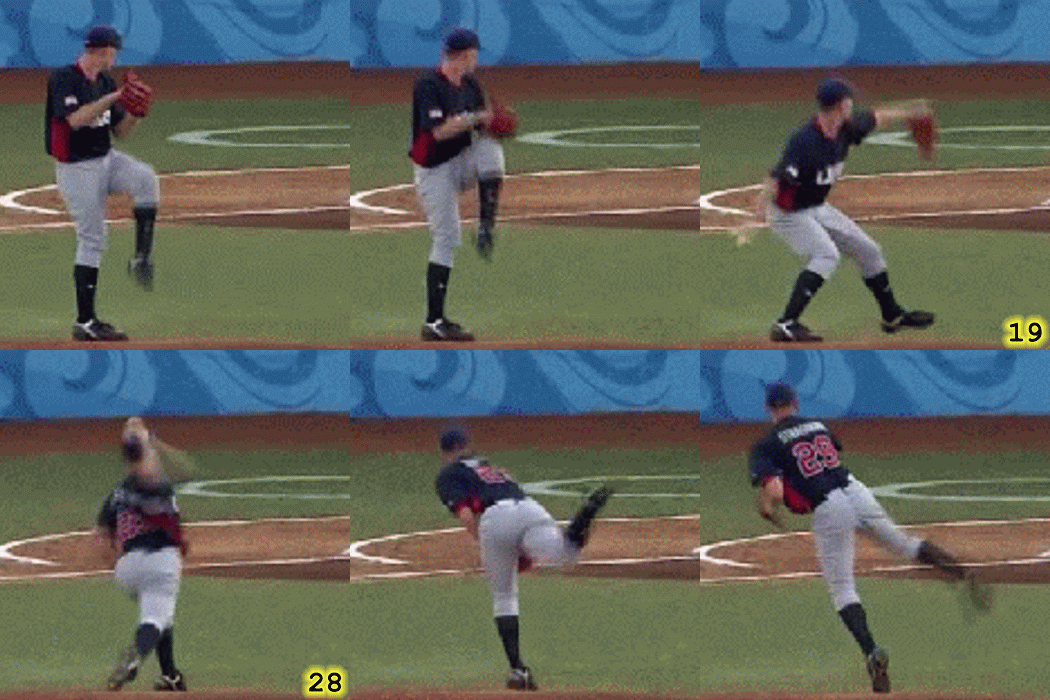
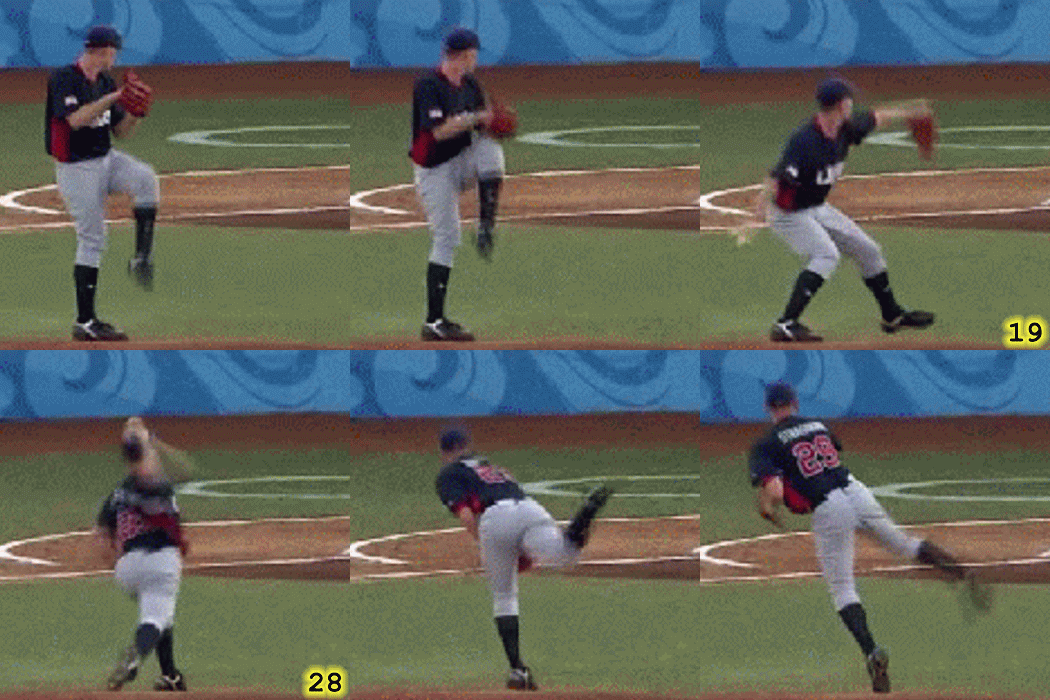
Mark Prior. The thing to pay attention to in this clip is the
borderline
Inverted W that is clearly visible in Frame 23 and Frame 24.
Stephen Strasburg
Stephen Strasburg's Inverted W
While the Inverted W isn't automatically bad, in Stephen
Strasburg's case it does appear to create a significant timing problem.
Notice that in Frame 26, when Stephen Strasburg's Glove Side
(GS) foot plants and his shoulders start to rotate, his Pitching
Arm Side (PAS) forearm is just above the horizontal rather than
being vertical (or nearly so) as I prefer. In Frame 27, when
Stephen Strasburg's shoulder's have clearly rotate a significant
amount, his PAS is still not yet vertical.
All of this causes Stephen Strasburg's PAS upper arm to
externally rotate especially hard and much (see Frame 29) which
significantly increases the load on the elbow and the shoulder.
What's more it looks like this external rotation, as with Mark
Prior, occurs with his PAS upper arm elevated in a position of
hyperabduction. If you combine
this with Stephen Strasburg's plus to plus plus velocity and the
fact that he seems to be a fastball/slider guy, rather than a
fastball/change-up guy, you've got
someone who is putting tremendous, and likely excessive,
stress on his elbow and his shoulder.
The Bottom Line on Stephen Strasburg August 2008
The bottom line on Stephen Strasburg is that, while he may be
a consensus number one like David Price, mechanically speaking
Stephen Strasburg is no David Price.
Like Mark Prior, Stephen Strasburg has some
Inverted W in his arm action and a timing problem as a
result (aka habitual
rushing).
This will significantly increase the load on his elbow and his
shoulder and make him a very high risk draft choice.
I could even see him pulling a Cole St. Clair and blowing up
mid-season. However, because his
mechanics in some of the frames I have seen aren't quite as bad
as Mark Prior's, and at times he sometimes makes the Horizontal W rather
than the Inverted W...
Stephen Strasburg
...there is a chance that Stephen Strasburg could
have a career more like a John Smoltz. In that case, he would be
effective for periods of time but would also struggle with elbow and shoulder problems.
It's a bit hard to say for sure, since Stephen Strasburg seems
to show significant variability in his arm action from year to
year.
Notes
[1] I just put together a new piece that discusses my views on
the overlap between pitching mechanics, injuries, the Verducci
Effect, and Pitcher Abuse Points.
|